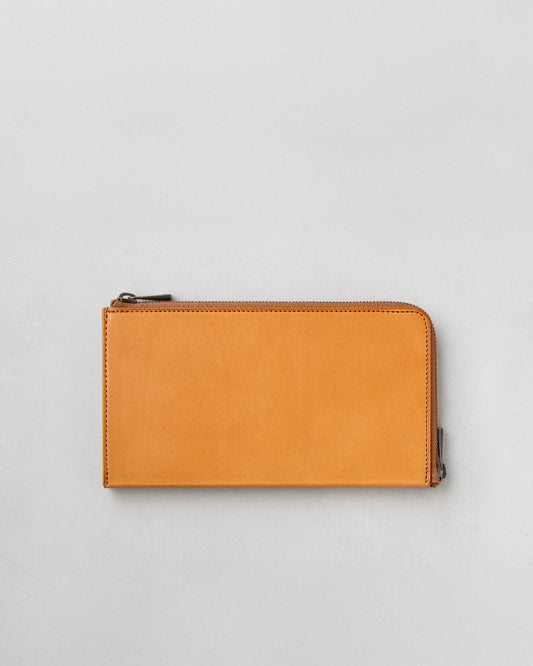

Redefining the compact long wallet.
Making a long wallet smaller.
At first glance, this idea seems rational.
However, there's a pitfall in its premise.
Convergence to the 10,000-yen bill size
Even with the rise of cashless payments, many people still choose long wallets. The ability to store bills without folding them. High visibility. The elegant motion of taking things out. These are charms that bifold wallets don't possess.
The trend of making these long wallets smaller to adapt to the times has spread. The answer chosen was the idea of "making it closer to the size of a 10,000-yen bill." Eliminating waste and minimizing external dimensions. At first glance, it seems rational.
However, this idea has an overlooked problem.
Cards cannot be arranged within the 10,000-yen bill size
A 10,000-yen bill measures 160 x 76 mm. What happens if you try to place two cards side-by-side here?
Whether placed vertically or horizontally, you cannot arrange two cards without them overlapping. No matter where you place them, a "band where all cards overlap" will always be created in the center.

the dark red band in the center will always be an area covered by all cards.
Even if you spread the cards out to the left and right, you cannot escape this band. It's the same for three or four cards. As long as it's a long wallet the size of a 10,000-yen bill, all cards will inevitably overlap in the center.
This is not a problem that can be avoided with clever design. It's a dimensional inevitability.
A "small long wallet" fundamentally cannot avoid becoming thick.
If storage capacity is reduced, the meaning of a long wallet disappears
If you try to reduce thickness, storage capacity will be reduced.
However, if you only need to store a few cards, there's no need to insist on a long wallet. A small, thin bifold wallet like the Hitoe® Fold offers superior portability and convenience.
A long wallet that has been made smaller by reducing storage capacity defeats its own purpose for being chosen.
Rephrasing the question
The question "How to make a long wallet smaller?" cannot solve this problem.
As long as the starting point is to reduce the external dimensions, thickness will inevitably arise.
"What should a long wallet be?"
Rephrasing the question changes what you see. The ability to store bills without folding them. The ability to see all contents at a glance. Sufficient storage capacity. These are the conditions that make a long wallet a long wallet.
If you start with these conditions, you realize that the problem is not just the external dimensions, but also the overlap of the stored items.
Structure determines form
Overlap can only be solved by structure.
That form is the double card pocket, announced in 2019.
It is slightly taller than the 10,000-yen bill size.
However, by distributing cards to two L-shaped locations, the overlap between cards is halved while maintaining the width of a 10,000-yen bill.
Furthermore, by utilizing the slightly increased height, cards and coins do not overlap.
Not a "small long wallet," but a "small, thin long wallet."
From the idea of reducing external dimensions, to the idea of simultaneously solving overlap.
Form emerges from the question.
(Text by Hirotaka Sato | Representative and Designer of SYRINX)