

Knowing What to Allow.
Leather expands and contracts, and each hide has unique properties. It is not a material suited to the dimensional precision expected of industrial products in the first place.
Nevertheless, Hitoe® Fold aims for a precision of ±0.5mm.
The workshops we commission for production often tell us that this level of precision is not typically required for leather products.
However, because the parts overlap precisely, if the corner radii are even slightly off, the contours won't align. If the positioning pins are even slightly off, the parts won't fit into the correct places, distorting the shape and breaking the sense of tension.
For example, consider the gap between the inner hook and the card pocket when the wallet is closed.
If designed with zero gap, leather expansion/contraction and errors in part fixing positions would directly affect the appearance when closed.
Therefore, we intentionally create a slight gap that can accommodate unavoidable errors.
Seeking precision while also allowing for error. That, too, is part of the design.
Die accuracy
By the way, the process of die-cutting leather uses steel rule dies.
The accuracy of these dies is crucial for the precision control mentioned above.
The dies typically used for leather products are made from what is known as Swedish steel.
This name comes from the fact that it was developed by Sandvik, a Swedish company.

Craftsmen manually bend the steel along the shape of the pattern, and finally, the frame and blade are spot-welded to fix the shape. However, in addition to manual errors, slight distortions are almost unavoidable during the welding process.
For regular leather products, as leather itself expands and contracts, this level of distortion is not an issue.
But this was not the case for Hitoe® Fold.
The radius overlap was slightly different.
The pin position was off by a mere 0.5mm.
Each time, we remade the die. Twice, three times.
This was a significant burden, not only in terms of time and money but also psychologically, for both our company placing the order and the die-making workshop receiving it.
Entrusting the blade to lasers
In the printing industry, there is a type of die called a Victoria die (also known as a Thomson die).
The blade is embedded in grooves precisely machined by laser. Therefore, it is characterized by ease of ensuring accuracy.
It is mainly used for die-cutting paper, stickers, and film.
Why hasn't the Victoria die become widespread in the leather industry?
Victoria blades (Thomson blades) are thinner than Swedish steel and require more frequent remaking due to wear and breakage. Additionally, blades embedded in plywood have poor visibility, which may not be an issue for paper or stickers, but for leather, it's necessary to die-cut while observing the condition of the grain side, which reduces work efficiency.
Furthermore, the cost of manufacturing the die jumps several times.
Since leather expands and contracts, such high precision is usually not necessary.
Matching the manufacturing method to precision
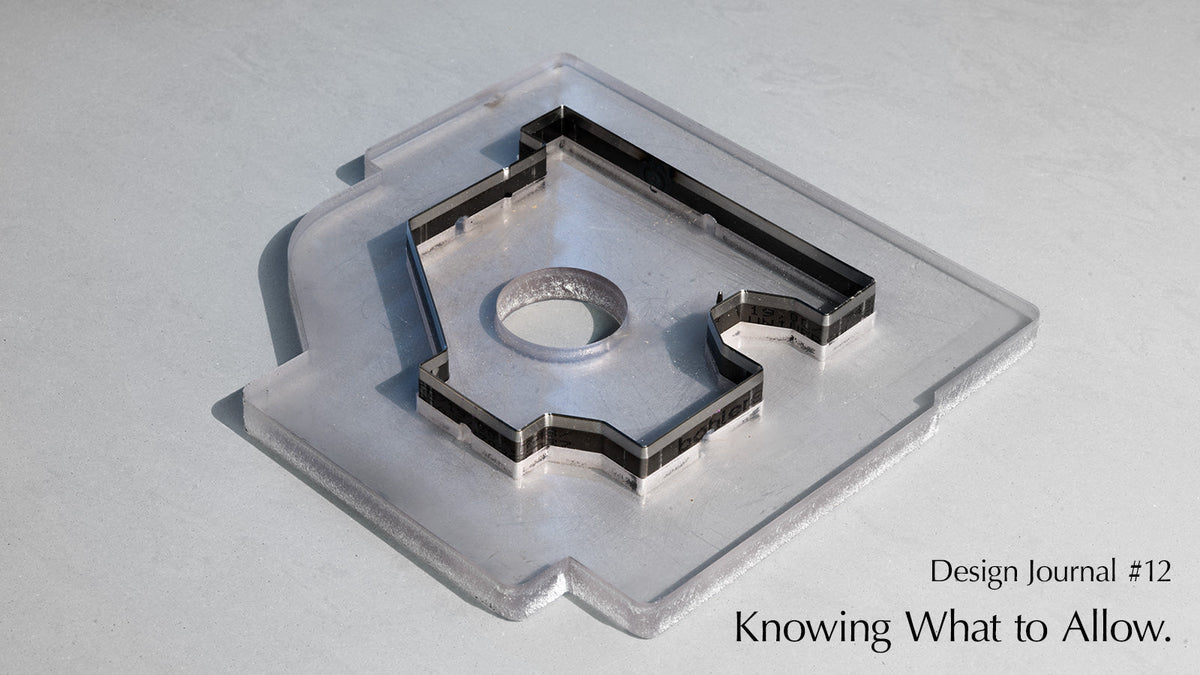
SYRINX assesses the required precision for each part and selectively uses Swedish steel and Victoria dies.
The low visibility of Victoria dies is compensated by using a transparent acrylic base, allowing for work while observing the surface being cut.
Swedish steel is used for parts where extreme precision is not required or where leather expansion/contraction can absorb errors.
In all designs, error control is a critical factor that influences quality and aesthetics.
Completely eliminating errors is impossible.
How those errors are handled reflects the designer's thinking.
Identifying errors.
The texture of each piece of leather is different.
That is something to be embraced.
Leather expansion/contraction and unavoidable manufacturing errors.
These are incorporated into the design in advance.
However, die errors are different.
Even a tiny error can directly affect the final shape.
Error and precision.
Rather than simply eliminating errors,
it's about identifying and controlling their boundaries.
It is beyond that point that SYRINX products are made possible.
(Text by Hirotaka Sato | SYRINX Representative and Designer)